Tactic 37 of 101 · AI Plays
How to Automate Event Listings Across 15 Free Sites
Free event-listing sites are the most ignored distribution on the internet: Craigslist, Patch, AllEvents, chamber calendars, the niche tech calendars. Each one is five minutes of form-filling nobody does. A browser bot does all fifteen from one file, so every event ships with free exposure and a stack of backlinks.
By Justin Novak · Updated November 4, 2026
- Ideal for
- B2B, Startups, Small Business
- Difficulty
- Easy
- Capital required
- None
- Time to execute
- Quick win (0 to 3 days)
- Scalability
- Medium
- Risk / reward
- Medium
Why it works
Event distribution has a long tail everyone skips. The big channels get all the attention: your list, your socials, your ads. Meanwhile fifteen free sites would happily list your event, and they sit empty, because fifteen clunky forms is an hour of nobody's time.
Automating the forms flips the math. The hour becomes one command, so the free channel actually gets used.
And registrations are only half the point. Every listing is a page on someone else's domain naming your event and linking your site. That's backlinks and third-party presence for free, which Google and AI search engines both read as evidence you're real.
How to run it
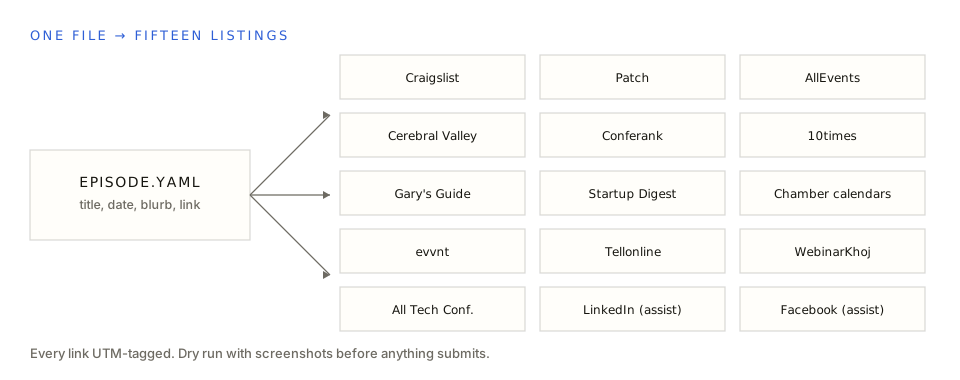
- One file per event. Title, date, time, description, registration link. The bot reads this and nothing else, so updating the event means editing one file.
- Pick your fifteen. Ours included Craigslist, Patch, AllEvents, Cerebral Valley, Conferank, 10times, Gary's Guide, Startup Digest, and local chamber calendars. Yours depends on your niche. The best lists mix the general sites with the two or three calendars your actual buyers check.
- Dry run first, always. The bot fills every form and screenshots the result without submitting. You review the screenshots once, then run it for real. That guardrail is what makes browser automation trustworthy.
- Tag everything. A UTM per site turns the blitz into a measurable channel. After three events you'll know which listings deserve their spot.
- Leave the walled gardens to humans. LinkedIn and Facebook get prepped copy and a checklist, not automation. Two manual minutes beat a banned account.
Real world example
We run this for a weekly AI webinar. One episode file fans out through a Playwright bot to around fifteen listing sites, every link UTM-tagged, every successful submission logged to a CSV. Craigslist, Patch, AllEvents, Conferank, and Cerebral Valley all took listings cleanly on the first real run.
Ongoing effort per episode: one command and a glance at the screenshots. Free exposure, a widening ring of backlinks, and registration surface area the event would never have otherwise. No extra effort, which is the whole reason it keeps happening.
Common questions
Do these little listing sites actually send registrations?
Some do. Others mostly hand you a backlink and one more indexed page pointing at your event. Both are wins at a cost of zero. UTM-tag every link so you learn which sites earn their spot in your fifteen.
How do I build the bot without being a developer?
Describe the job to an AI coding agent: here's my event file, here are the sites, fill each form and stop before submitting. Browser automation from a spec is exactly what these agents are good at now. Keep a dry-run mode that screenshots every filled form before anything goes live.
What about LinkedIn and Facebook events?
Keep them in assist mode: the bot preps the copy and a checklist, a human posts. Platforms that police automation aren't worth the account risk when posting manually takes two minutes.
Related plays
How to Build a Tools Directory That ChatGPT Cites
Turn the tools you actually use into a programmatic directory with first-party notes. 65 pages from one spreadsheet, built for Google, ChatGPT, and Perplexity.
How to Turn Voice Notes Into SEO Case Studies
A six-question voice note after every job becomes a full case study page that ranks on Google and gets cited by ChatGPT. The founder talks; AI publishes.
How to Turn One Project Into 30 Social Posts
Every finished job becomes three posts fanned across ten platforms: around 30 placements from one project. AI writes from verified facts; you approve once.
The playbook keeps growing
Get new plays as they ship.
The playbook is growing to 101+ tactics. One email when new plays drop. No pitch, just plays.
You’re in. New plays will find you.