Tactic 36 of 101 · AI Plays
How to Build a Tools Directory That ChatGPT Cites
Every tool you use in your business is a page someone is searching for. A directory of those tools, with honest notes on how you actually use each one, is programmatic SEO that AI search engines love to cite: dozens of indexable pages generated from one spreadsheet you could fill in from memory.
By Justin Novak · Updated November 4, 2026
- Ideal for
- Startups, B2B, SaaS, Small Business
- Difficulty
- Medium
- Capital required
- None
- Time to execute
- Mid-term (1 to 3 weeks)
- Scalability
- High
- Risk / reward
- Medium
Why it works
Tool searches are endless, specific, and commercial: best scraper for lead lists, Beehiiv versus alternatives, what CRM for a small agency. The aggregator sites answer those searches with scraped marketing copy. You can answer them with experience, because you actually run these tools every day. That's the thing Google and AI assistants are both trying to surface, and almost nobody gives it to them.
There's a compounding effect too. Every time a tool comes up in your articles, show notes, or case studies, you link your own page for it, and that page links back to the work. The directory becomes the hub your site's authority routes through.
How to run it
- One spreadsheet, honest columns. Name, category, link, and the two sentences that matter: how we actually use it, and who it's for. If you've got nothing honest to say about a tool, it doesn't get a row.
- Generate pages, not posts. A fixed template per row: what it is, how we use it, which projects or episodes it shows up in, who should pick it. Dozens of pages exist the moment the build runs.
- Make it machine-readable. Structured data on every page, and the full set listed in llms.txt so Google, ChatGPT, Perplexity, and Copilot can each walk the whole directory.
- Wire the mentions. Tool comes up in your content, link your page for it. Every time.
- Maintain by addition. New tool in the stack, new row in the sheet. The system handles the rest, which is why this survives a busy calendar.
Real world example
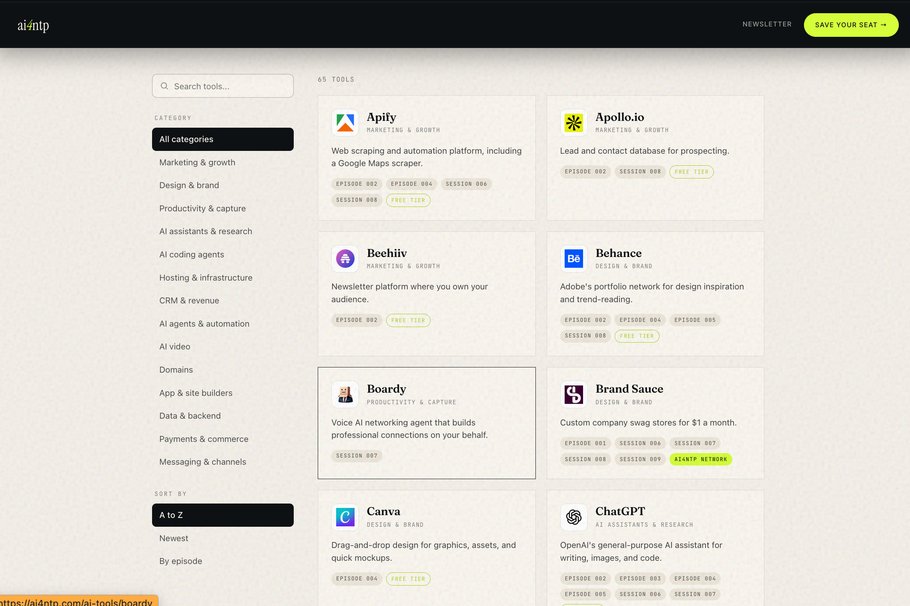
For our AI webinar series we built a directory of 65 tools, generated from a single Google Sheet. Every page carries first-party notes plus tags for the episodes where the tool was used live, and it ships with structured data and llms.txt coverage.
The part I like most: it's fully automated, so the directory grows as a side effect of just running the show. One honest spreadsheet, maintained in minutes, working SEO, AEO, and GEO at the same time.
Common questions
Why would this rank when there are a thousand AI tool directories?
The first-party notes. Every page says how we actually use this, which project or episode it showed up in, and what we'd tell a friend. Aggregator directories scrape marketing copy. Yours carries experience, and that's the difference both Google and LLMs are filtering for.
How is this automated?
The source of truth is one spreadsheet: name, category, link, your usage notes. The build generates a page per row with structured data, updates llms.txt, and redeploys. Adding a tool is adding a row.
What does this do for AI search specifically?
When someone asks ChatGPT or Perplexity what tool to use for a job, the engines look for pages that pair the tool with real usage context. A first-party directory entry is exactly the shape they cite, and every citation introduces your brand.
Related plays
How to Turn Voice Notes Into SEO Case Studies
A six-question voice note after every job becomes a full case study page that ranks on Google and gets cited by ChatGPT. The founder talks; AI publishes.
How to Automate Event Listings Across 15 Free Sites
A browser bot takes one event file and fills the forms on 15 free listing sites: free exposure, backlinks, and omnichannel registration with no extra effort.
How to Turn One Project Into 30 Social Posts
Every finished job becomes three posts fanned across ten platforms: around 30 placements from one project. AI writes from verified facts; you approve once.
The playbook keeps growing
Get new plays as they ship.
The playbook is growing to 101+ tactics. One email when new plays drop. No pitch, just plays.
You’re in. New plays will find you.