Tactic 30 of 101 · AI Plays
How to Use AI to Improve Your Email Marketing
Your sent folder is a dataset. Every campaign you've ever sent holds a lesson about what makes your list open, click, and book a meeting. No human is going to read 123 campaigns and cross-reference every send. AI will, in an afternoon. Then a second set of agents tries to tear every finding apart, so only the real patterns survive.
By Justin Novak · Updated November 4, 2026
- Ideal for
- B2B, Small Business, SaaS, Service Business
- Difficulty
- Medium
- Capital required
- None
- Time to execute
- Quick win (0 to 3 days)
- Scalability
- High
- Risk / reward
- High
Why it works
Think about what's actually in play in one email:
- the name of the sender
- the subject line
- the time of day it went out
- the day of the week
- the length of the email
- a call to action versus no call to action
- a picture versus no picture
- a link versus no link, and how that link is phrased
That's eight dimensions on a single send. Across 123 campaigns, it's a matrix with thousands of cells, joined to who actually opened, clicked, and converted. None of this was feasible before AI. Not because the data didn't exist. Because nobody was ever going to do those joins by hand. Too much for a person. Trivial for a model.
We ran exactly this on a client's outbound program: 123 campaigns, over 210,000 per-recipient delivery rows, joined at the person level to CRM outcomes. Out the other side came a ranked playbook of 18 copy rules.
The adversarial step
Here's the part most people skip. A first-pass analysis will lie to you, because it confuses the list with the copy. Your best subject line probably went to your warmest list. Of course it won.
So after the mining pass, we set up separate verifier agents with one job: attack every finding. "That was the list, not the copy." "That was the send time, not the subject." Every rule had to survive cross-examination against the data. Most didn't. The ones that did are the playbook.
What survived
Three of the surviving rules, measured in conversions per 1,000 emails sent:
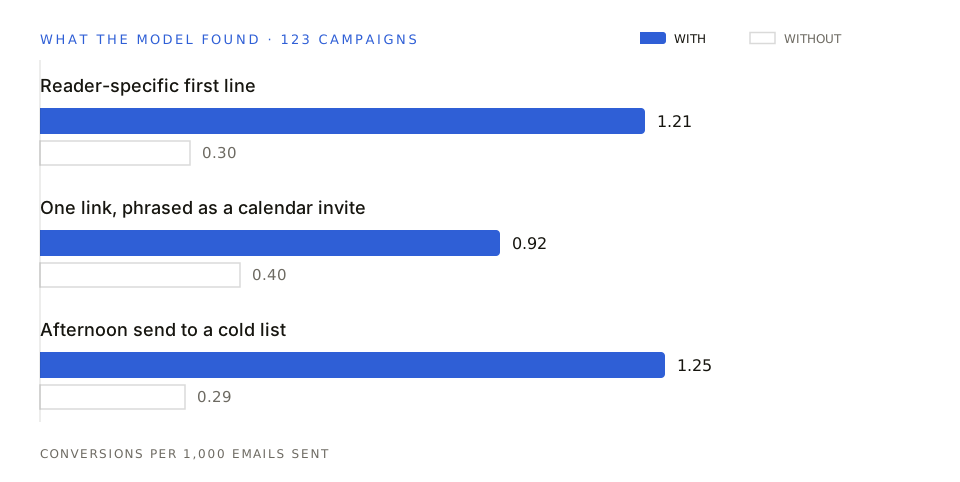
A first line about the reader (their company, their world, not yours) converted at 1.21 per 1,000 against 0.30 for a generic opener. One single link phrased as a calendar invite beat a bare link 0.92 to 0.40. Afternoon sends to cold lists beat mornings 1.25 to 0.29. No guessing anywhere. It all came out of data we already owned.
One more that changes how you schedule follow-ups: 90% of conversions landed within 24 hours of a send. If a campaign is quiet on day two, it's done. Send the next one.
How to run it
- Export everything: campaigns, subject lines, send times, body copy, and per-recipient outcomes from your email platform and CRM.
- Have AI classify every campaign across the dimensions above and join the results at the person level. That's hours of agent time, not weeks of analyst time.
- Run the adversarial pass. Separate agents argue against every finding. Keep what survives.
- Write the survivors down as the playbook your next campaign has to follow. Keep feeding new sends back in so the rules sharpen over time.
The target metric is whatever a conversion means to you. For us it was registrations that became booked meetings. Swap in demos, replies, or signed proposals. The method doesn't care.
Common questions
How many campaigns do I need before this is worth running?
The pattern recognition starts working around 30 to 50 sends. Below that, treat the findings as hypotheses to test, not rules. We ran it on 123 campaigns with over 200,000 per-recipient delivery rows.
What data do I actually feed the model?
Exports from your email platform and CRM: campaign name, subject line, sender, send time, body copy, and per-recipient outcomes. The joins happen at the person level, which is exactly the tedious part AI is good at.
Why the adversarial step? Why not trust the first analysis?
Because the first analysis confuses the list with the copy. A subject line that crushed with warm prospects didn't win because of the words. Verifier agents attack each finding with alternative explanations, and you only keep what survives.
Related plays
How to Turn One Webinar Into 30 Days of Content
One recording becomes clips, articles, a newsletter, and follow-up emails: 32 pieces and 118 placements a week, every quote verified against the transcript.
How to Use AI to Analyze Your Sales Pipeline
Connect your CRM to Claude through an MCP server and ask your pipeline questions in plain English. What should I chase this week? costs less than pennies.
How to Show Clients Their Finished Space With AI
Put an AI render of the prospect's actual room, finished, on the cover of the proposal. They stop evaluating a quote and start seeing their own result.
The playbook keeps growing
Get new plays as they ship.
The playbook is growing to 101+ tactics. One email when new plays drop. No pitch, just plays.
You’re in. New plays will find you.